The One You Left on the Shelf: What the Souvenir You Didn't Buy Says About You
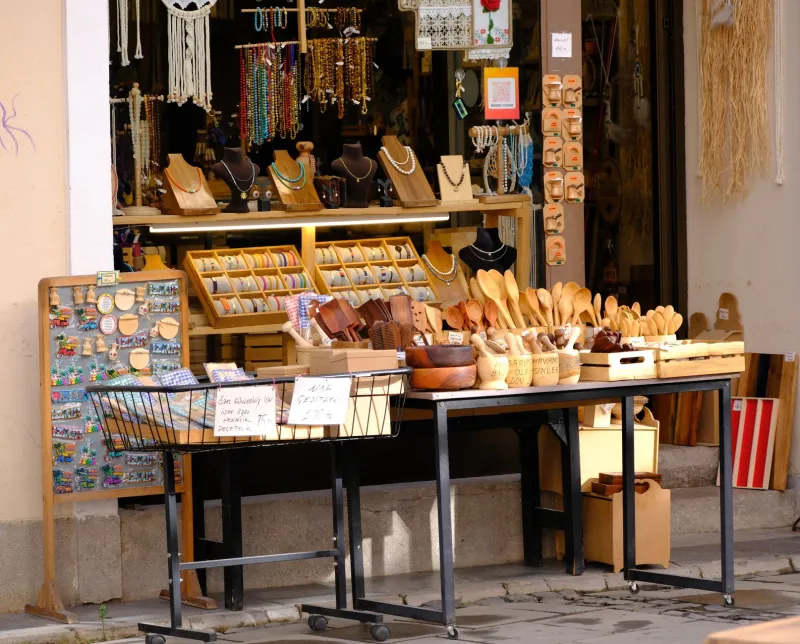
You remember it perfectly. A hand-thrown ceramic bowl at a market stall in Santa Fe. A small oil painting propped against a whitewashed wall in Savannah. A woven textile hanging in a shop doorway somewhere in the Southwest that caught the afternoon light in a way you've never quite been able to describe. You picked it up. You turned it over. You did the math in your head — twice — and then you set it back down and walked away.
And you've thought about it, off and on, ever since.
There's a whole category of travel memory that doesn't get talked about enough: the things we almost brought home. Not the overpriced airport keychains we grabbed out of obligation, not the fridge magnets that seemed like a good idea at the time. The real ones. The objects that meant something in the moment, that we actively chose to abandon, and that somehow managed to follow us home anyway — invisibly, stubbornly, living rent-free in the back of our minds for years.
What's that about? And what does it actually say about who we were on that particular day, in that particular place?
The Practical Voice That Wins Every Argument
Most of us have a version of the same internal monologue. It kicks in right around the moment something beautiful catches our eye. Where would I even put this? How would I get it home without it breaking? I already have too much stuff. I don't need it. It's overpriced. I can find something like it back home. (Spoiler: you never do.)
That voice isn't wrong, exactly. It's just operating from a completely different set of priorities than the part of you that was drawn to the object in the first place. The practical voice is thinking about checked baggage fees and apartment square footage. The other part of you — the one that reached out and touched the thing — was responding to something harder to name. Beauty, maybe. Or the desire to carry a piece of a moment forward into your regular life.
When the practical voice wins, we tell ourselves it was the responsible call. And sometimes it genuinely is. But the fact that we remember these non-purchases so vividly suggests that something more complicated was happening.
What Hesitation Actually Costs
Travel has a way of loosening the rules we live by at home. You eat things you'd never order at your neighborhood restaurant. You strike up conversations with strangers in ways that would feel weird on your own street. You stay out later, sleep in a different position, and generally give yourself more permission to just be somewhere without optimizing every minute.
And yet, when it comes to buying something — especially something handmade, something local, something that costs more than a souvenir shop trinket — a lot of us snap right back into our most cautious, most budget-conscious selves. The looseness disappears. The fun version of us takes a break while the spreadsheet version steps in to handle the transaction.
This isn't just about money, though money is certainly part of it. For a lot of Americans, spending on objects that aren't strictly useful carries a faint whiff of guilt, even when we're on vacation and the whole point is to enjoy ourselves. We're a culture that's pretty comfortable dropping $80 on a dinner we'll forget in a week, but somehow a $60 piece of handmade art feels like a splurge that requires justification.
The object we didn't buy often represents the version of ourselves we weren't quite ready to be that day — the person who trusts their own taste, who doesn't need to defend their purchases, who believes that beauty is worth paying for even when no one else will see it.
The Haunting Is the Point
Here's the thing about the souvenirs that got away: they tend to haunt us in a very specific way. Not with regret exactly, but with a kind of wistful curiosity. What would my life look like if that bowl had been on my kitchen shelf all this time? It's a small question, but it's also kind of a big one.
Physical souvenirs anchor memories to objects. You see the thing, you remember the trip. But the souvenirs we left behind do something different — they anchor us to a version of ourselves that existed for just a moment, in just that place, before we talked ourselves back into being practical. They're like photographs of a road not taken.
Psychologists sometimes talk about "omission regret" — the regret we feel not for things we did, but for things we didn't do. Research consistently shows that over time, we tend to regret inactions more than actions. The embarrassing thing you said on a trip fades. The thing you were too cautious to do or buy or say? That one tends to stick.
Which means every time you think about that textile, that painting, that ceramic piece — you're not just remembering an object. You're remembering a moment when you had a choice, and you chose the safer path.
What You Can Do With That Information
None of this is meant to be a guilt trip about past purchases (or non-purchases). The point isn't to go back and buy everything that catches your eye from here on out. Plenty of those impulse buys end up in closets or donated to Goodwill three years later.
But it's worth asking yourself, next time you're standing in front of something that genuinely moves you in a market or a gallery or a roadside shop: Who is the part of me that wants this, and why am I about to override it?
Sometimes the practical voice is right. Sometimes the timing really isn't there, the budget really is tight, the logistics really are impossible. But sometimes — maybe more often than we admit — the hesitation is less about practicality and more about permission. The permission to spend money on something just because it's beautiful. The permission to trust your own eye. The permission to be the kind of traveler who brings home art instead of keychains.
The Shelf It Never Sat On
There's a particular kind of bittersweet that comes from picturing exactly where you would have put the thing. The corner of the living room. The windowsill in the kitchen. The wall above the desk. You can see it there, even though it never arrived.
That empty spot isn't really about the object anymore. It's about the version of yourself who would have bought it — the one who was a little more confident, a little less worried, a little more willing to say yes to the things that stopped them in their tracks.
Travel has a way of showing us who we could be, if we let ourselves. And sometimes the clearest picture of that person isn't in the photos we took or the things we packed. Sometimes it's in the one we left on the shelf.