Nobody Gets It But You: The Strange Souvenirs We Can't Stop Defending
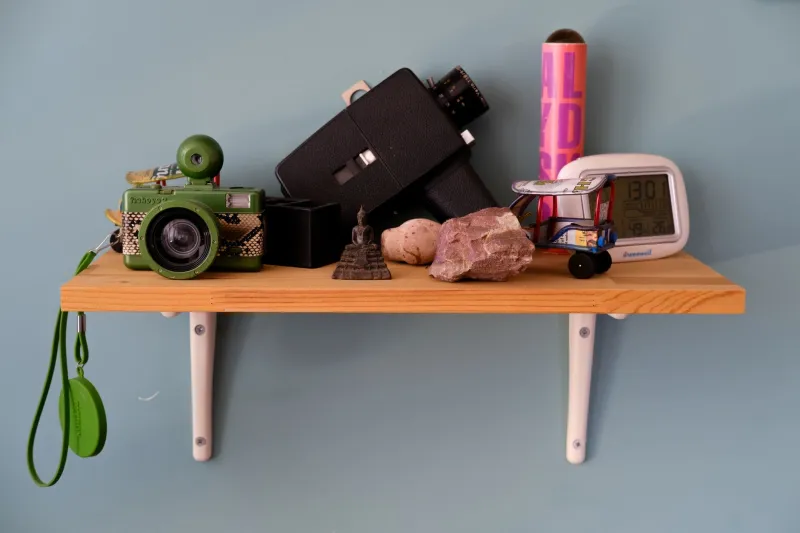
There it is, sitting on your bookshelf between a succulent and a framed photo from your cousin's wedding. A ceramic frog wearing a tiny sombrero. A chunk of pink Himalayan salt shaped vaguely like a duck. A laminated menu from a diner in rural Nebraska that doesn't exist anymore. Whatever it is, you know the look people give it — that slow, polite nod that says I have questions but I'm not sure I want the answers.
And yet, you keep it. You moved it from your last apartment. You wrapped it carefully in a sweater when you packed. You would genuinely be upset if something happened to it.
So what is going on there?
The Postcard Problem
For a long time, travel souvenirs followed a pretty predictable script: snow globe, magnet, maybe a novelty t-shirt if you were feeling adventurous. These things made sense. They were legible. You could hand your grandmother a little Statue of Liberty figurine and she'd know exactly what to do with it.
But somewhere along the way, a lot of us stopped buying the expected stuff — or at least, stopped caring about it the way we care about the random, inexplicable things we picked up instead. The mass-produced keychains collect dust. The weird duck-shaped salt rock? That thing has prime real estate on the shelf.
The difference isn't really about the object. It's about what the object holds.
It's Never Really About the Thing
Here's what nobody tells you when you're standing in some cluttered little shop in coastal Maine or a flea market outside of Santa Fe: the moment you reach for something unusual, you're not just buying a trinket. You're pressing pause on a specific feeling — the particular quality of light that afternoon, the way you were laughing with someone, the version of yourself you were being in that place at that time.
Psychologists who study autobiographical memory talk a lot about how physical objects serve as what they call retrieval cues — basically, touchstones that give your brain a shortcut back to a moment. The weirder and more specific the object, the stronger and more exclusive that connection tends to be. A generic snow globe could belong to anyone's memory. A hand-painted wooden spoon you bought from a guy named Gerald at a craft fair in Vermont? That's yours alone.
That specificity is actually the whole point.
The "Why Did You Buy That" Conversation
Let's be real: part of the fun of the weird souvenir is the explaining. Not in an exhausting way — more like, someone picks it up, gives you that look, and suddenly you're telling a story you haven't told in months. You're back in that moment. You're animated. You remember details you didn't even realize you'd held onto.
No one ever asked you to explain a refrigerator magnet shaped like the state of Florida. But a small, hand-thrown pottery mug from a one-woman studio in Asheville that you found on a solo road trip the summer you quit your job? People lean in for that one. And in telling it, you remember things — the smell of the studio, the conversation you had with the artist, the way the afternoon felt wide open and a little terrifying in the best possible way.
The strange souvenir becomes a portal. And sometimes it tells people more about who you are than a hundred Instagram posts ever could.
Why Your Friends' Side-Eye Doesn't Actually Matter
There's a particular kind of social pressure that comes with taste — the sense that what we display in our homes says something about us, and that something should be legible and acceptable to others. Minimalist shelves. Curated aesthetics. Nothing too chaotic.
And then there's the ceramic frog.
Here's the thing: the people who matter in your life — the ones who really know you — eventually come around on the weird souvenir. Or they ask about it and end up loving the story. The side-eye usually comes from people who haven't heard the explanation yet, not from people who've decided it's objectively terrible.
More than that, there's something quietly brave about keeping an object that doesn't fit neatly into anyone else's aesthetic vision for your life. It says: this mattered to me, in a way that's mine, and I'm not editing it out. That's actually kind of a big deal.
The Ones That Hurt to Think About Losing
You can usually identify your most meaningful souvenirs by doing one simple test: imagine losing them. Not the snow globe — you'd replace that without blinking. But the other thing. The weird thing. The thought of it getting broken in a move or accidentally thrown away by a well-meaning roommate produces a specific, disproportionate dread.
That reaction is information. It's your brain telling you that this object is load-bearing in some way — that it's doing real work in how you store and access a piece of your own story.
A friend of mine has a small, slightly lopsided ceramic bowl she bought at a street market in New Orleans on a trip she took after a really brutal breakup. It's not pretty. The glaze is uneven and one side is visibly lower than the other. She uses it to hold paper clips on her desk. But she has described, with complete sincerity, that losing that bowl would feel like losing a photograph. Because for her, it basically is one.
Collecting the Uncollectable
Some people are deliberate about their weird souvenirs — they actively seek out the local, the handmade, the strange, the one-of-a-kind. Others stumble into it accidentally, reaching for something on a whim and only later realizing they've carried it across three states and two apartments without ever questioning why.
Either way, what you end up with over time is something more interesting than a collection. It's a kind of autobiography told in objects. A shelf full of things that don't match, don't make sense together, and couldn't possibly be explained all at once — but that each hold a whole world in them if you know which questions to ask.
So yeah. Keep the ceramic frog. Keep the laminated menu. Keep whatever it is that your friends quietly judge every time they come over.
Because the day someone picks it up and asks about it, you're going to light up. And that story — the real one, the one only you know — is worth every weird look it took to get there.