Thirty Thousand Feet and Suddenly You're Telling a Stranger Your Whole Life
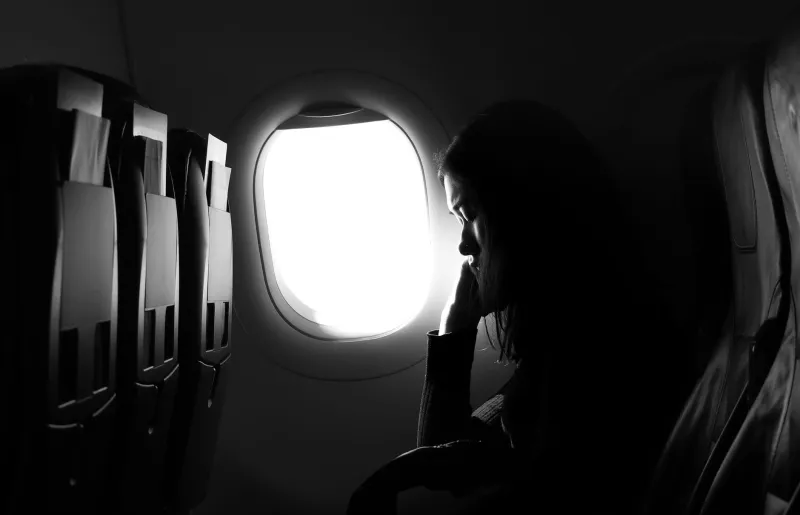
You didn't plan to say any of it. You ordered your ginger ale, pulled out your book, and fully intended to stare at the same page for three hours while pretending to read. Then the person in 14B said something offhand — maybe about the turbulence, maybe about the city you were both leaving — and forty-five minutes later you were talking about your marriage, your career pivot, the dream you keep almost pursuing. You landed a different person than the one who boarded.
If this has happened to you, you're not alone. And if it hasn't yet, buckle up.
Why the Airplane Does Something to People
There's actual psychology behind why we open up at altitude. Researchers who study social behavior have long noted that physical environments shape how vulnerable we're willing to be. Airplanes create a very specific cocktail of conditions: you're temporarily removed from your regular life, there's a low-grade ambient anxiety that loosens inhibitions, you're physically close to a stranger with nowhere to go, and — crucially — you know you'll almost certainly never see this person again.
That last part is the key ingredient. Therapists sometimes call it the "stranger on a train" effect, though the airplane version has its own particular intensity. When the relationship has a built-in expiration date measured in flight hours, the usual social calculus changes completely. There's no reputation to protect. No mutual friends who might find out. No awkward run-in at the grocery store six months later. You can say the real thing.
And people do. Oh, they really do.
The Things We Confess at 35,000 Feet
Ask around and the stories come fast. A woman on a red-eye from Los Angeles to New York tells the guy next to her — a retired teacher from Ohio she'd never met — that she's been offered her dream job in another city but is terrified to leave her aging parents. He listens for an hour, then says something so simple and so right that she still thinks about it. She took the job.
A guy flying home to Dallas after a work conference admits to his seatmate that he hasn't been happy in years and doesn't know if it's his career or his city or something he can't name yet. His seatmate — a woman who'd made a major life change in her forties — doesn't give advice. She just asks questions. Good ones. He journals for the first time in his life that night in his hotel room.
A college student heading back to campus after a rough semester ends up in a conversation with a middle-aged businessman that turns into a two-hour discussion about failure, reinvention, and what it actually means to figure yourself out. The businessman hands him a book title before they deplane. The student reads it three times.
None of these conversations were planned. All of them mattered.
The Pressure Cooker Effect
There's something else at play beyond anonymity. Airplane conversations happen in a kind of suspended time. You're not at work. You're not at home. Your phone is on airplane mode. Your to-do list is temporarily unreachable. For a few hours, you exist in a liminal space where the normal demands of your life can't quite get to you.
In that gap, things surface. Questions you've been too busy to sit with. Feelings you've been outrunning. The stuff you told yourself you'd deal with "later."
And then someone asks a simple question — "So what do you do?" or "Where are you headed?" — and suddenly you're not giving the rehearsed answer. You're giving the honest one.
That's the pressure cooker at work. Altitude plus anonymity plus suspended time equals a weird, fleeting permission to be real.
Why We Don't Tell Our Friends This Stuff
Here's the part that's worth sitting with: why is it easier to tell a stranger on a plane things we'd never say to our closest friends?
Part of it is the no-consequences factor we already talked about. But there's more to it. With close friends and family, we manage impressions. We have a version of ourselves we've been presenting for years, and deviating from it feels risky — like it might change how they see us, or worse, confirm a fear we have about ourselves. The stranger doesn't have that version of you. They only have the version sitting in seat 14A right now, talking honestly for the first time in months.
There's also no history. No context that colors everything you say. A stranger doesn't remember the last time you said you were going to make a change and didn't. They just hear what you're saying today, and they respond to that.
It's almost like a clean slate — one that only exists for the duration of a flight.
When the Conversation Actually Changes Something
Not every airplane talk is profound, of course. Plenty of them are pleasant small talk that fades before you've even collected your luggage. But the ones that stick — the ones people bring up years later — tend to share a few qualities.
They happen when at least one person is at a crossroads, even if they didn't realize it when they boarded. They involve real listening, not just waiting to talk. And they usually include some moment where someone says something that reframes the way you've been seeing your own situation.
The stranger doesn't have to give you the answer. They just have to be present enough to help you hear yourself think out loud. That's often enough.
Some people have made major decisions — career changes, relationship choices, moves across the country — that they trace back, at least in part, to something a seatmate said somewhere between Chicago and Phoenix. That's a lot of weight for a conversation that started over shared armrest negotiations.
What to Do With the Next One
If you want more of these conversations in your life — and honestly, who wouldn't — the formula is pretty simple. Put the phone away. Take out the earbuds, at least for a while. When someone says something, respond with actual curiosity instead of a closed answer that signals you're done talking.
You don't have to be the one who opens up first. Sometimes the most powerful thing you can do is ask a good question and then genuinely listen to the answer. People are carrying more than they let on, and sometimes a stranger on a plane is exactly the right audience.
Maybe you'll hear something that shifts your thinking. Maybe they will. Maybe the conversation will evaporate the second you hit the jetway and that's okay too.
But if you're sitting there right now — or the next time you're at 35,000 feet, somewhere between wherever you've been and wherever you're going — consider lowering the armor just a little. The person next to you might have exactly the words you didn't know you needed. Or you might have theirs.
Either way, it beats staring at the same page for three hours.